
NCCE Approves Continuous 5-Year NCE to Degree Programme for Colleges of Education
The Nigerian education sector has recorded another major milestone following the official approval and implementation of the Continuous Five-Year NCE to Degree Programme by the National Commission for Colleges of Education (NCCE). The development is expected to reshape the academic structure of Colleges of Education across the country and create better opportunities for students pursuing careers in teaching and education.
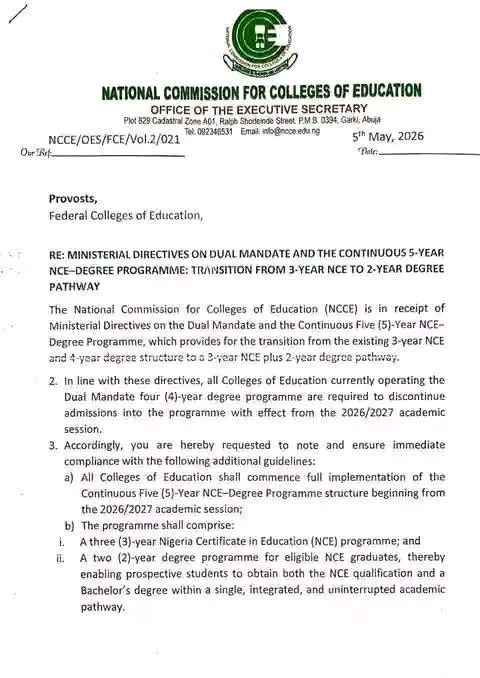
According to recent directives released by the NCCE on May 5, 2026, all Colleges of Education operating under the Dual Mandate system are expected to begin full implementation of the newly approved structure from the 2026/2027 academic session. The policy introduces a more coordinated and seamless academic transition for students who intend to progress from the Nigeria Certificate in Education (NCE) programme to obtaining a Bachelor’s Degree.
Understanding the New 5-Year Structure
Under the newly approved framework, students will spend three years completing the NCE programme before proceeding directly into a two-year degree programme within the same institution. This means that eligible NCE graduates will no longer need to seek admission into another university before obtaining a degree qualification.
The structure is specifically designed to simplify the academic journey for students in Colleges of Education. Instead of graduating with an NCE and beginning another lengthy admission process elsewhere, students can now continue directly into the degree programme at the 300 Level, provided they meet the academic requirements set by their institutions and the NCCE.
This policy is expected to save students time, reduce financial stress, and encourage more Nigerians to pursue careers in education and teaching.
What Is the Dual Mandate Programme?
The Dual Mandate programme allows Colleges of Education in Nigeria to award both NCE certificates and Bachelor’s Degrees. In previous years, many Colleges of Education depended heavily on affiliations with universities before they could run degree programmes. However, the Federal Government later granted selected institutions the authority to independently award degrees under strict NCCE supervision.
With the implementation of this new 5-year structure, Dual Mandate Colleges are expected to fully integrate both the NCE and Degree programmes into a single academic pathway.
This reform is also expected to improve administrative coordination and academic planning within Colleges of Education nationwide.
Benefits of the New NCE to Degree Programme
The newly introduced programme comes with several important advantages for students, parents, institutions, and the Nigerian education system in general.
1. Easier Transition to Degree Programme
One of the biggest advantages of the policy is the smooth transition from NCE to Degree level. Students who successfully complete their NCE studies can proceed directly into the Bachelor’s Degree programme without writing fresh entrance examinations or applying through complicated admission processes.
2. Reduced Academic Stress
Many NCE graduates often face difficulties when seeking admission into universities after graduation. The new structure eliminates unnecessary delays and uncertainties by allowing students to continue within the same institution.
3. Financial Advantages
Since students can complete both programmes within one academic environment, parents and guardians may spend less on relocation, multiple admission processing fees, and other associated expenses.
4. Improved Teacher Education
The Federal Government and the NCCE introduced this policy partly to strengthen teacher education in Nigeria. By creating a continuous pathway from NCE to Degree, more students may become motivated to remain within the teaching profession and acquire higher qualifications.
5. Increased Value of the NCE Qualification
The NCE remains the minimum teaching qualification in Nigeria. This new policy further strengthens its importance by connecting it directly to degree education in a more structured system. Explore More on How to get full scholarship in Europe
Impact on Students and Aspirants
The announcement has generated excitement among students and admission seekers across Nigeria. Many prospective students who were previously uncertain about choosing Colleges of Education may now reconsider due to the improved opportunities attached to the new programme.
Aspirants now have the opportunity to begin and complete both their NCE and Degree education within a shorter and more organized framework. This could also lead to increased admission applications into Colleges of Education in coming years.
Current NCE students are also expected to benefit greatly from the reform, especially those studying in institutions already operating the Dual Mandate system.
NCCE’s Commitment to Educational Development
The National Commission for Colleges of Education continues to play a major role in improving teacher education and academic standards across Nigeria. The introduction of the Continuous Five-Year NCE to Degree Programme reflects ongoing efforts by the Federal Ministry of Education and the NCCE to modernize the nation’s educational system.
Educational stakeholders have described the development as a progressive step capable of improving the quality of teachers produced in Nigeria. Many believe the programme will also increase the attractiveness of Colleges of Education and help address teacher shortages in schools nationwide.
Implementation Begins in 2026/2027 Session
The NCCE has directed all eligible Colleges of Education operating the Dual Mandate programme to begin implementation from the 2026/2027 academic session. Institutions are expected to release detailed admission guidelines and transition procedures in line with the approved structure. Read also: Jamb Vs Direct Entry Admission
Students and aspirants are therefore advised to stay updated through official announcements from their respective institutions and the NCCE.
Conclusion
The approval of the Continuous Five-Year NCE to Degree Programme marks a significant achievement for the Nigerian education sector. The initiative is expected to simplify academic progression, strengthen teacher education, and create better opportunities for students across the country.
For many aspiring educators, the policy represents a fresh beginning and a more reliable path toward obtaining both professional teaching qualifications and university degrees within a coordinated system.
As implementation begins in the 2026/2027 academic session, stakeholders remain hopeful that the programme will positively transform Colleges of Education and contribute meaningfully to the future of education in Nigeria.
